
Last updated September 24, 2026
Free in-home measure and quote - PGT, CGI and CWS impact lines compared on your actual openings, style by style

 Before
 After
After Before
 After
After Before
 After
AfterSeasonal Windows & Doors Care for Sunrise: Year-Round Homeowner’s Guide
The single highest-risk month for window frame water intrusion in Sunrise is June. Not because of hurricane strikes, but because daily afternoon storms, peak humidity, and thermally expanded frames stress sealant joints that dried and contracted all winter. In our experience measuring openings across Sunrise since 2012, the damage we document in early July almost always began with a sealant failure that started in the dry months and revealed itself only when the first sustained rains arrived. This guide is built around Sunrise’s actual bi-seasonal pattern: a dry season from November through April and a wet season from May through October, each imposing distinct stress on window and door systems that a generic four-season maintenance guide will not address. For more guides & resources tailored to South Florida homeowners, see our blog.
Quick Answer
Seasonal window and door care in Sunrise means inspecting sealant joints and weep drainage in April before the wet season begins, monitoring for condensation and frame swelling during June through August’s peak humidity, and scheduling any replacement work during November through March when dry conditions allow proper curing and installation. Our Window Installation Maintenance Checklist for Sunrise Homeowners provides a month-by-month breakdown of these tasks. Homeowners should check impact-rated glazing for seal integrity after every named storm passes within 100 miles, and never apply storm shutters to already-installed impact glass without verifying manufacturer clearance.
Table of Contents
- Dry Season Tasks: November Through April
- Pre-Wet-Season Inspection: April Checklist
- Mid-Wet-Season Monitoring: June Through August
- Hurricane Prep for Existing Windows and Doors
- Post-Storm Inspection Protocol
- When to Schedule Replacement Work in Sunrise
- Common Mistakes to Avoid
- When to Call a Professional
- Frequently Asked Questions
 Before
 After
AfterDry Season Tasks: November Through April
Sunrise’s dry season runs roughly November through April, with relative humidity dropping to 50-60% and daytime highs settling in the 70s and low 80s. This is when window and door systems recover from summer stress, and it is also when hidden damage becomes diagnosable.
The contraction of vinyl and aluminum frames during cooler, drier months opens gaps that were tight in August. Sealant joints that looked sound in September may reveal hairline separations by January. We measure this directly: a 72-inch vinyl frame that measured 71-15/16 inches in July will often measure a full 72 inches in January, and that 1/16-inch difference either compresses the sealant or pulls it away from the substrate.
What to Inspect Each Dry Season
- Check all sealant joints for separation. Run a dull putty knife along the interior and exterior perimeter of every frame. If the blade slips in more than 1/8 inch, the bond has failed. Mark the location with painter’s tape and photograph it; this becomes your baseline for April’s pre-wet-season repair.
- Exercise all hardware. Hinges, locks, and rollers that sat idle through summer’s constant air conditioning can develop corrosion that you will not notice until you try to open a window in March. Operate every opening at least twice. If a sliding door requires more than 8 pounds of force to move (about the weight of a half-gallon of milk), the rollers need service.
- Inspect weatherstripping for compression set. After six months of summer heat, rubber and silicone weatherstripping can lose resilience. Close a window on a sheet of paper; if you can pull the paper out without tearing it, the seal is compromised.
- Document frame squareness. Use a framing square or a smartphone level app on the interior sill. A frame that has racked more than 1/4 inch out of square indicates structural movement or installation failure and will leak under wind-driven rain.
This is also the optimal window for any window replacement in Sunrise. Caulk cures predictably between 50°F and 85°F. Foam backer rod expands correctly. Installers can work without scheduling around afternoon thunderstorms. At Sightline Windows & Doors Sunrise, our measured surveys during these months produce the most accurate sightline dimensions because thermal expansion is at its minimum.
Homeowners in neighborhoods like Sawgrass Estates and Welleby often ask us to schedule major projects for January or February specifically because their HOA maintenance windows align with dry-season contractor availability. We keep the written quote from that measured survey; under Haven Clause 1, it becomes the final invoice document with no change orders.
Pre-Wet-Season Inspection: April Checklist
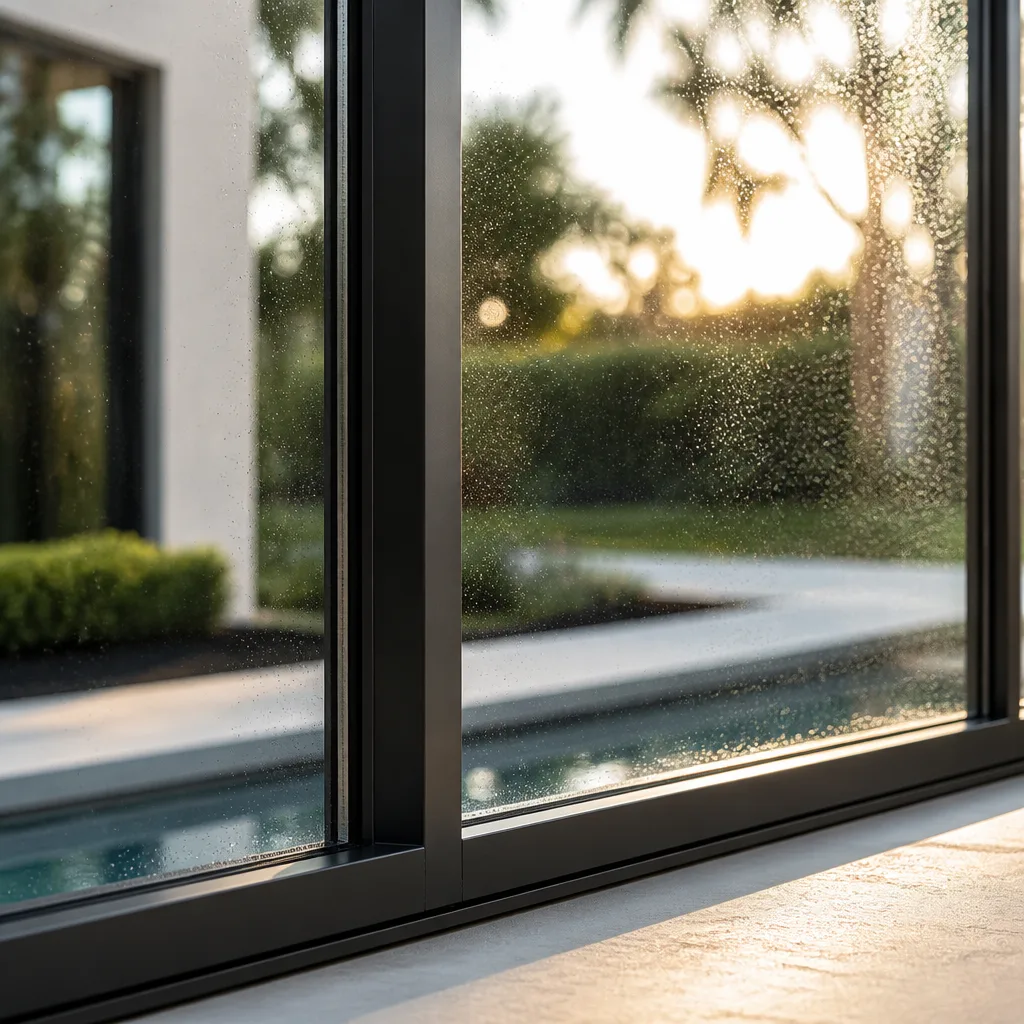
April in Sunrise is transitional. The average rainfall jumps from 3.1 inches in March to 4.5 inches in April, and by May the afternoon storm pattern is fully established. The inspection you complete in April determines whether June’s daily deluges enter your walls or drain properly to the exterior.
The Three-Critical-Point Inspection
Every window and door opening has three water management features that fail predictably in our climate: sealant, weep drainage, and sill pan drainage. We inspect all three on every window installation in Sunrise we complete, and we recommend homeowners check them annually.
Sealant integrity: Apply the putty knife test again to any joints you marked in January. If separation has grown, the joint needs complete removal and reapplication, not a bead-over repair. In Sunrise’s humidity, silicone sealant requires 24-48 hours of dry conditions to achieve full adhesion. April typically offers enough consecutive dry days; May does not.
Weep hole function: Weep holes are the small slots or tubes at the bottom of window frames that allow infiltrated water to drain outward. They clog with pollen, insect debris, and salt residue. Use a pipe cleaner or compressed air to clear them. Then pour 8 ounces of water into the track; it should exit the weep hole within 30 seconds. If it pools, the internal drainage channel is blocked and the frame will overflow into the wall cavity during the first sustained rain.
Sill pan and slope: The exterior sill must slope away from the house at minimum 1/4 inch per foot. Set a level on the sill; if it slopes toward the interior or is dead flat, water will sit against the frame bottom and eventually find a path inside. This is especially common in Sunrise homes built between 1985 and 2005, where original installations often omitted proper sill pan flashing.
Hardware Lubrication and Adjustment
Before humidity rises, lubricate all moving parts with a dry PTFE lubricant, not oil-based products that attract dust. Adjust latch strike plates so that closed windows compress weatherstripping by approximately 30% of its original thickness. Too little compression leaks air and water; too much crushes the material and destroys its memory.
If your home has impact-rated windows from manufacturers like PGT or CGI, verify that the laminated glass edge is fully encapsulated in the frame. UV exposure and thermal cycling can degrade the edge seal over 10-15 years, and April’s moderate temperatures are the last comfortable opportunity to address this before summer heat makes handling large glass units hazardous.
Mid-Wet-Season Monitoring: June Through August
June is the pivot point. Average rainfall in Sunrise reaches 9.8 inches, afternoon storms arrive with near-clock regularity, and relative humidity stays above 75% day and night. The thermal expansion that began in April reaches its maximum, and the sealant joints you inspected in April are now under their greatest mechanical stress.
What to Watch During Active Rain Events
Do not wait for a hurricane to test your windows. A typical June afternoon thunderstorm in Sunrise produces 1-2 inches of rain in 45 minutes with sustained winds of 25-35 mph. That is enough to reveal most installation deficiencies.
During the next heavy rain, inspect the interior perimeter of every window and door within 30 minutes of the storm’s peak. Look for:
- Condensation between panes. In dual-pane units, fogging that cannot be wiped from either surface indicates seal failure. The desiccant inside the spacer is saturated, and the unit’s insulating value is effectively zero. In Sunrise’s humidity, this will not improve; it will worsen until the interior glass runs with water.
- Water staining at the corners. The bottom corners of window frames are where water collects if weep drainage is inadequate. A stain the size of a quarter suggests intermittent overflow; a stain larger than a half-dollar indicates continuous intrusion and probable wall cavity damage.
- Frame sweating on the interior. Aluminum frames that sweat during summer indicate inadequate thermal break or missing insulation. The frame surface is below the dew point of the interior air. This is not a sealant issue; it is a product specification issue that may require replacement with thermally improved framing.
- Operational binding. Vinyl frames expand in heat; if a window that operated smoothly in January now requires force to close, the frame may be expanding against an out-of-square rough opening. Forced closure stresses hardware and compromises the seal.
Documenting Water Intrusion Location Precisely
If you find water, document it before it dries. This is standard practice on every Sightline job under Haven Clause 4 (Evidence on every job), and we recommend homeowners adopt the same discipline.
- Photograph the water location with a ruler or coin for scale, showing the relationship to the frame corner or hardware.
- Note the time, storm duration, and wind direction.
- Mark the interior wall with pencil (not permanent marker) at the highest point of the stain.
- Check the corresponding exterior location within 24 hours for visible sealant gap, weep blockage, or flashing defect.
This documentation is what separates a $200 sealant repair from a $2,000 wall remediation. When we provide a door installation in Sunrise or any other service, the photo record we leave with the customer uses this same protocol so that future service calls reference the same landmarks.
Hurricane Prep for Existing Windows and Doors

Sunrise’s hurricane season officially runs June 1 through November 30, with peak activity August through October. Preparation for existing windows and doors depends entirely on whether the glazing is impact-rated or non-impact.
Impact-Rated Glazing: What It Does and Does Not Need
Impact-rated windows and doors, including products from PGT, CGI, and CWS that we specify for coastal exposures, are tested to ASTM E1886 and E1996 standards. They are designed to withstand a 9-pound 2×4 missile at 50 feet per second and subsequent cyclic pressure loading. The laminated glass may crack but will remain in the frame, maintaining the pressure envelope.
These products do not require storm shutters for code compliance. However, they are not indestructible. The frame anchorage, not the glass, is the typical failure point in over-roof applications. Before any named storm, verify that:
- Exterior trim and fasteners are intact; no corrosion on exposed screws
- Operable impact units lock securely; the interlock between sash and frame is what resists positive pressure
- No temporary protective film or construction residue remains on glass, which can bake on in post-storm sun
Do not apply storm shutters over impact glass unless the window manufacturer specifically permits it. The additional dead load can compromise the frame anchorage, and trapped heat between shutter and glass can stress the laminate. We have documented this on post-storm inspections in Sunrise where homeowners added shutters “for extra protection” and induced frame distortion that the storm itself did not cause.
Non-Impact Glazing: Mandatory Protection
Non-impact windows and doors require tested protection: shutters, plywood cut to fit and anchored with 5/8-inch lag screws into structural framing, or impact-rated fabric panels. The Florida Building Code requires this protection in the High-Velocity Hurricane Zone, and Sunrise’s location in Broward County means most homes fall under this requirement.
Plywood is the minimum; it is not equivalent. Untested plywood will not stop wind-borne debris at design pressures, and improper fastening creates more dangerous projectiles than no protection at all. If your home still has non-impact glazing, the dry season is the time to budget for window replacement in Sunrise with impact-rated products. The measured survey we provide under Haven Clause 1 includes a written scope for both full opening replacement and shutter removal.
Post-Storm Inspection Protocol
Within 48 hours of a named storm passing within 100 miles of Sunrise, inspect every window and door opening. Not for catastrophic damage, which is obvious, but for subtle failures that will propagate if unaddressed.
The Four-Area Check on Every Opening
- Glass integrity. In laminated impact units, look for spiderweb cracking that may not have penetrated the inner lite. This is not a cosmetic issue; cracked laminate has reduced capacity for the next event and compromised UV protection for the interlayer. Photograph all cracks with scale reference.
- Frame anchorage. Check interior trim for new gaps between trim and wall, or nail pops in the surrounding drywall. These indicate frame movement under load. A frame that shifted 1/8 inch has permanently deformed its sealant bed and will leak in ordinary rain.
- Hardware function. Operate every lock and latch. Corrosion from wind-driven rain can seize mechanisms within 48 hours in salt air. A lock that operated before the storm but binds after it needs immediate service; it is the primary pressure-resisting element in an operable unit.
- Surrounding wall and soffit. Water entry at windows often originates at roof or wall failures above the opening. Check for staining on the wall above and to the sides of each window, and for soffit vent displacement that indicates pressure differential across the structure.
Document everything with dated photographs. Under the Haven Standard’s 365-Day Done Right Promise, Sightline customers can submit this documentation with a service request and we will schedule inspection without re-measuring fees. The photo record from your original installation becomes the baseline for comparison.
Homes in Sunrise’s older sections, particularly those built before Andrew-era code changes in 1992, often show differential settlement after storm loading that first manifests as window binding. If multiple windows in one wall become difficult to operate simultaneously, structural assessment takes priority over hardware adjustment.
When to Schedule Replacement Work in Sunrise
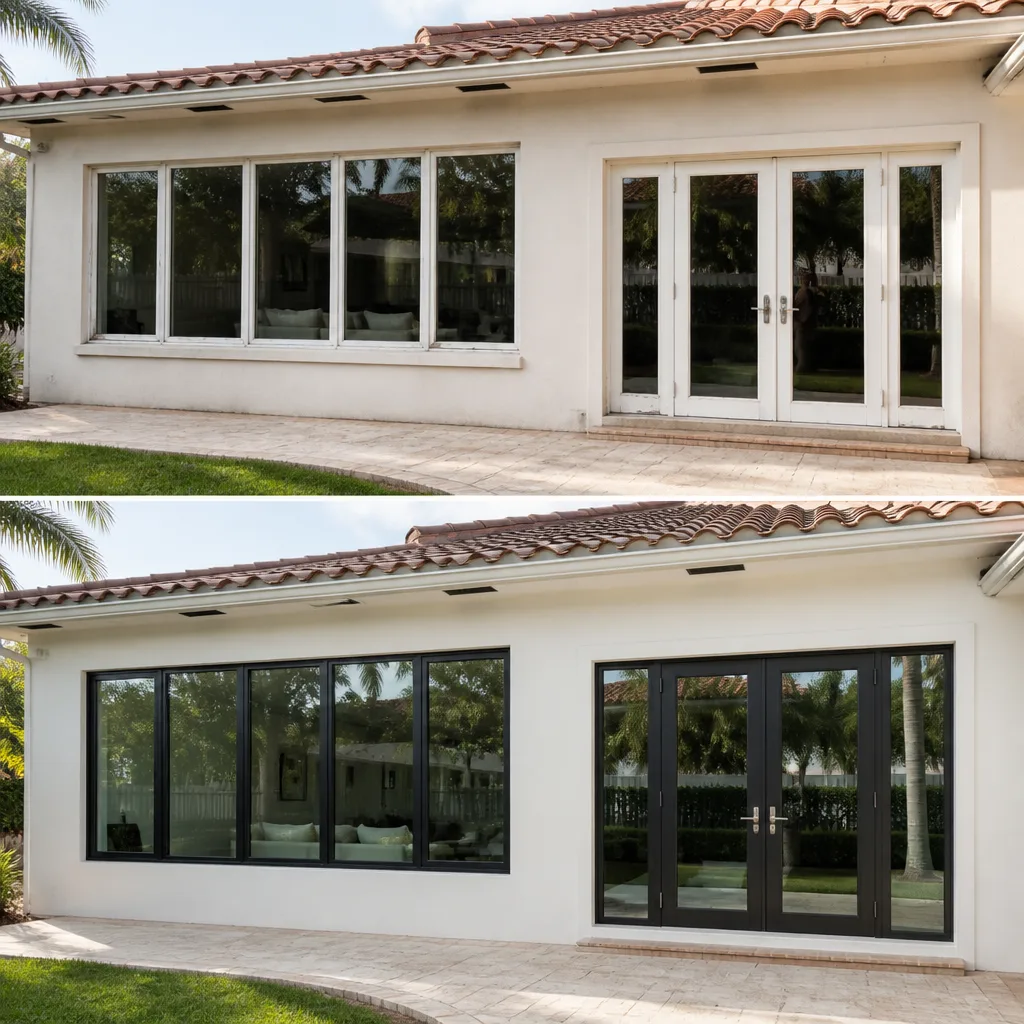
Timing matters for installation quality, not just contractor availability. The materials we specify from PGT, CGI, CWS, and ES Windows each have temperature-dependent handling requirements, and the sealants and foams that complete the installation have curing windows that Sunrise’s climate constrains.
Optimal Replacement Window: November Through March
Dry-season replacement offers:
- Predictable sealant curing: silicone and polyurethane products cure in 24-48 hours at 70°F and 50% relative humidity
- Minimal thermal expansion during measurement and installation, reducing the gap tolerance we must build into the rough opening
- Lower risk of rain interruption, which can compromise open-wall exposure and force rescheduling
- Better foam expansion: low-expansion polyurethane backer foams perform predictably between 60°F and 80°F; above 85°F they can over-expand and distort frames
We schedule our most complex custom and geometric window installations during these months because the sightline measurements we record in the customer’s kept survey are stable. A geometric window measured at 78°F in February will fit the opening measured; the same window measured at 92°F in July may require field adjustment that adds labor and risks seal compromise.
Wet-Season Replacement: When Necessary
Sometimes replacement cannot wait. Seal failure that allows continuous water intrusion, or impact damage that compromises the pressure envelope, requires immediate action. In these cases, we specify fast-cure sealants rated for application to damp surfaces, schedule around the daily storm pattern (starting work at 7 AM to complete wall closure before afternoon storms), and use temporary protection if walls must remain open overnight.
The written quote from our measured survey includes a wet-weather contingency clause when applicable, so the price does not change if we must return to complete exterior sealant application on a subsequent dry morning. This is Haven Clause 5 (No surprises) in practice.
Common Mistakes to Avoid
- Applying silicone sealant over old silicone without full removal. New silicone does not adhere to cured silicone. The repair looks complete but will fail at the first thermal cycle. In Sunrise’s expansion-contraction environment, this typically means within 90 days.
- Pressure-washing window and door frames directly. High-pressure water forces past weatherstripping and into weep channels, carrying debris deeper into the drainage system. It also drives water behind vinyl siding and into the rough opening. Use low-pressure rinse and soft brush only.
- Installing storm shutters on impact-rated glass without manufacturer verification. As noted above, this can void warranty and induce frame failure. We have replaced PGT and CGI units in Sunrise where this exact error caused corner cracking that the manufacturer documented as installation-related, not product-related.
- Ignoring weep holes because “the windows are new.” Weep holes clog fastest in new construction because surrounding landscaping generates maximum pollen and dust in the first 2-3 years. New windows in Sunrise often fail first because homeowners assume maintenance is deferred.
- Using oil-based lubricants on hardware in humid climate. These attract airborne salt and dust, forming abrasive paste that destroys precision mechanisms. PTFE dry lubricant only.
- Waiting for “hurricane season” to inspect impact glass. By August, any June-July damage has already allowed water into wall cavities. The inspection belongs in April, before the stress occurs.
- Accepting verbal assurances on warranty coverage. Every manufacturer of the eight lines we carry, including ECO Window Systems and ES Windows, publishes specific maintenance requirements. Failure to document annual maintenance can void warranty claims. We provide a maintenance log template with every installation.
When to Call a Professional
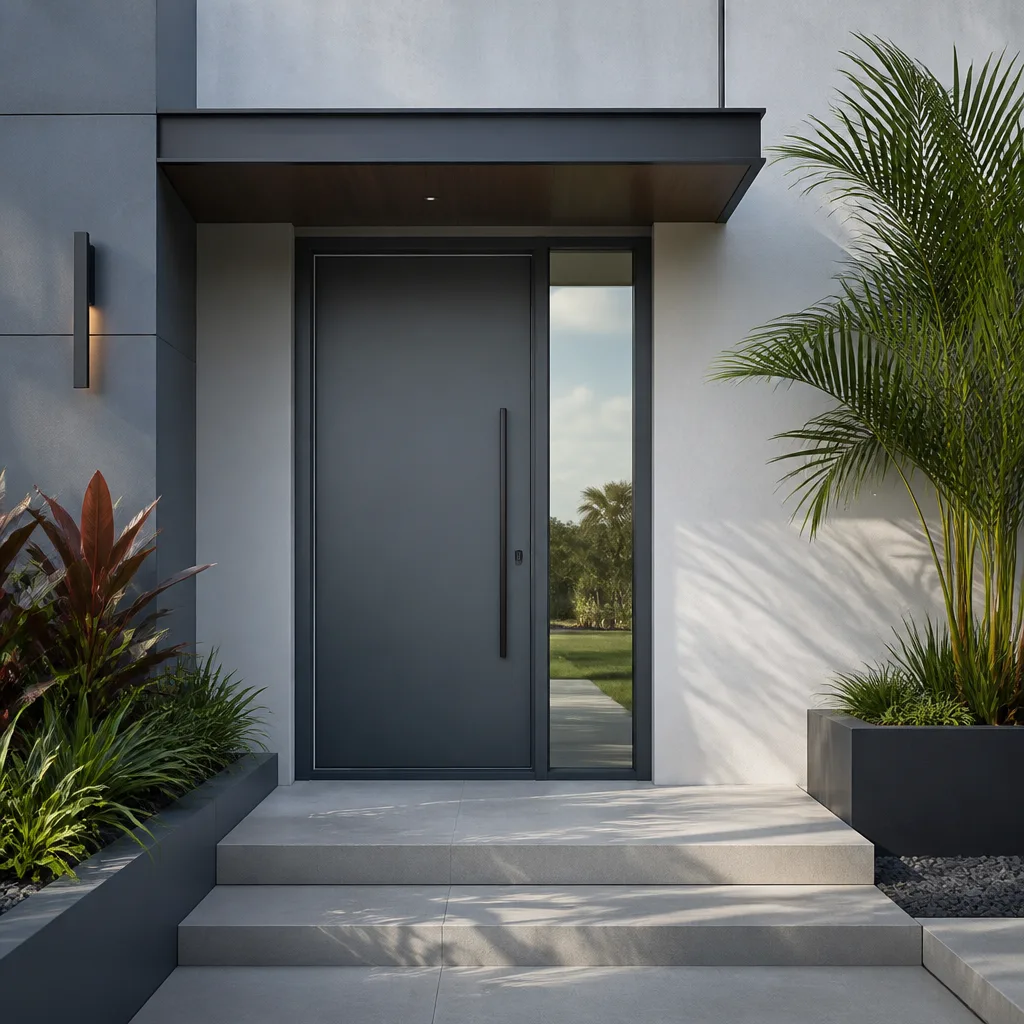
Some conditions require trained assessment, not homeowner monitoring. Call a licensed window and door contractor if you observe: continuous fogging between panes that persists more than 48 hours after rain; water stains that grow between storms, indicating active leakage rather than condensation; frame racking or corner separation exceeding 1/4 inch; or impact glass cracking of any dimension. These conditions indicate failure modes that DIY repair cannot address safely or effectively.
Sightline Windows & Doors Sunrise offers free estimates in Sunrise. Our measured survey produces a written scope and price before any work begins, and we will review any competitor’s written estimate at no charge under our Free Second Opinion policy. Call (754) 254-5294 to schedule. All technicians are background-checked, uniformed, and identified by license number before arrival, per Haven Clause 3.
Frequently Asked Questions
Professional sealant removal and replacement for a standard residential window in Sunrise typically runs $85 to $175 per opening, depending on frame material and access difficulty. For complete pricing context, see our Windows & Doors Cost Breakdown: The Sunrise Homeowner’s Reference for 2026. Multi-story applications or stucco repair after sealant removal add $50 to $150 per opening. This assumes sound framing and flashing; if water damage has compromised the substrate, repair costs escalate to $400 to $800 per opening for sheathing replacement and proper sill pan installation. Call (754) 254-5294 for an exact quote; estimates are free and include a documented photo record of the condition we find.
No. Sightline’s written quote from the measured survey is the final invoice under Haven Clause 1. The only price change occurs if the customer adds scope, such as additional openings or upgraded hardware. We have operated this way since 2012 across 18,000+ installations.
Yes. Window and door replacement in Sunrise requires a building permit from the City of Sunrise Building Division, with product approval documentation for impact-rated products and energy compliance verification for all installations. See our guide to Windows & Doors Permits, Codes & Inspections in FL: What You Need to Know for details. We pull permits as standard scope, include inspection scheduling, and pass all inspections before final payment. The permit record becomes part of your documented file.
Standard replacement of 10 to 15 openings in a single-family home requires 2 to 3 working days for installation, plus permit acquisition time of 5 to 10 business days. Custom or geometric units add 4 to 6 weeks for manufacturing. We schedule installation only after materials are in hand and permits are approved, so the work proceeds continuously without weather delays.
Impact window installation requires product-specific anchorage patterns, Florida Building Code compliance verification, and permit inspection. Improper installation voids manufacturer warranty and may fail under design load. We do not recommend DIY installation for impact-rated products. The documented photo record we provide under Haven Clause 4 exists precisely because proper installation is not visually verifiable to an untrained observer.
Impact-rated windows carry a permanent label or etched marking indicating the design pressure rating, product approval number, and manufacturer. In Florida, this is typically a Florida Product Approval (FPA) number or Miami-Dade County Notice of Acceptance (NOA). If you cannot locate this marking, the unit is likely not impact-rated. We verify this during our free estimate and document it in the written scope.
The best brand is the one whose specifications match the opening’s exposure, structural capacity, and your performance requirements. For direct coastal exposure in Sunrise, we often specify PGT or CGI for their higher design pressure ratings and proven laminate interlayer performance. For inland energy-focused applications, CWS or ES Windows may offer better U-factor and SHGC combinations at equivalent price points. We specify by performance tier and price range, not by margin or inventory. The measured survey determines the recommendation, not a sales target.
The Bottom Line
Sunrise’s bi-seasonal climate demands a bi-seasonal maintenance approach. Inspect sealant and hardware during the dry months when contraction reveals gaps. Complete pre-wet-season drainage verification in April before daily storms begin. Monitor for condensation and frame stress during June through August’s peak humidity. Understand whether your glazing is impact-rated and protect it accordingly. Document everything, especially after storms, because the evidence you gather in August determines whether November’s repair is minor or major. Replacement work belongs in the dry season for material performance reasons, not just contractor scheduling. The homeowners who avoid water damage in Sunrise are not the ones with the most expensive windows; they are the ones who inspect systematically and address findings before the next season’s stress begins.
Written by Sonia Raman, Owner at Sightline Windows & Doors Sunrise, serving Sunrise since 2012.